
The Ultimate Guide to Ergonomic Deflection Loupes: Save Your Career
Chronic pain should not be an accepted cost of practicing dentistry. For decades, practitioners have accepted neck strain and back fatigue as inevitable professional hazards. However, the emergence of advanced ergonomic deflection loupes is fundamentally altering the clinical landscape, shifting the paradigm from baseline endurance to complete musculoskeletal longevity.
By implementing innovative refractive optics, these devices allow clinicians to execute highly precise procedures while maintaining an ideal, upright posture. In this comprehensive guide, we will break down the underlying biomechanical science, compare industry-standard designs, and explore how updating your magnification system can effectively secure and prolong your professional career.
- Eliminate Cervical Strain: Achieves a true 0-degree upright neutral neck flexion posture.
- Advanced Optical Technology: Utilizes precision roof prisms to bend light pathways seamlessly.
- Career Extension: Drastically reduces the onset vectors of chronic Dental Musculoskeletal Disorders (MSDs).
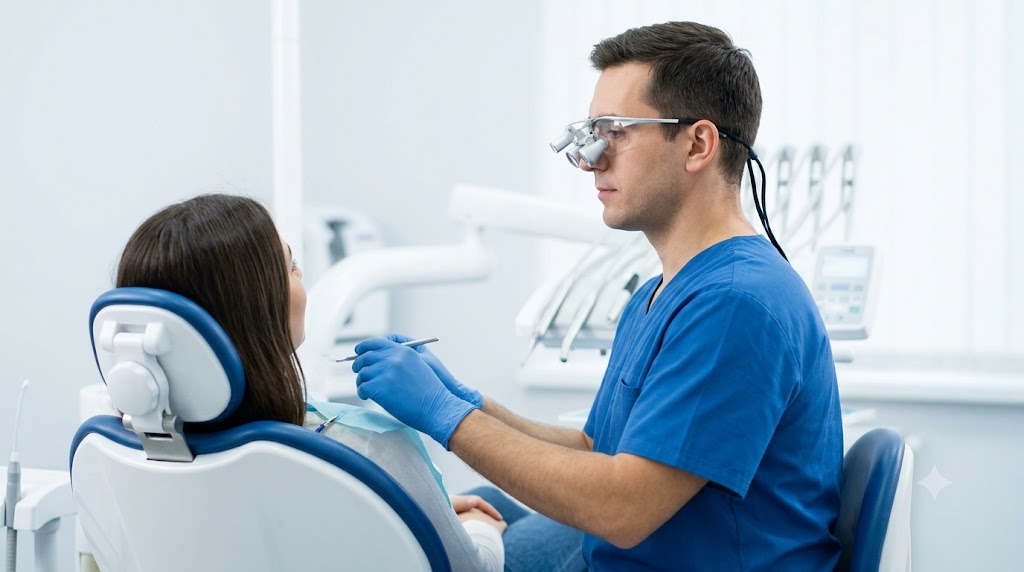
The Crisis Below the Surface: Dental Musculoskeletal Disorders (MSDs)
The prevalence of musculoskeletal pain among dental professionals is staggeringly high. Continuous micro-movements combined with static, unbalanced postures place immense physiological stress on the spine, shoulders, and upper muscle groups over extended operational windows.
Why Traditional Dentistry Causes Cervical Spine Strain
When operating with naked vision or traditional magnification systems, the clinician is forced into a forward-leaning stance. This prolonged forward position forces the neck out of alignment, creating substantial cervical spine strain. Over time, this constant mechanical strain can cause severe muscle fatigue, micro-tears, and eventual disc degeneration.
What are Ergonomic Deflection Loupes and How Do They Work?
Unlike standard vision solutions, modern ergonomic deflection loupes rely on specialized positioning arrays to re-route your visual field. They enable you to look directly forward while your actual line of sight is redirected cleanly downward into the oral cavity.
The Science of Refractive Prism Optics
At the center of this evolutionary leap is the implementation of a high-grade refractive prism optics assembly. Instead of a straightforward line-of-sight tube, these systems employ an internal roof prism configuration. Light entering the lens assembly is precisely bent at an optimized angle, ensuring an crystal-clear, sharp, and highly magnified field without requiring the operator to tilt their head downward.
Clinical Biomechanics: Analyzing Upright Neutral Neck Flexion
Achieving a safe ergonomic environment relies entirely on maintaining a correct biological alignment. Upright neutral neck flexion is achieved when the clinician's head remains balanced perfectly over the cervical midline, keeping muscle strain near zero.
Calculating the Physical Load on a Dentist's Neck
The human head weighs approximately 10 to 12 pounds in a completely neutral position. Biomechanical studies indicate that for every 15 degrees of forward head tilt, the relative physical load exerted on the cervical spine doubles. By eliminating this declination angle completely via deflection paths, you actively neutralize this compounding structural stress.
Traditional TTL vs. Flip-Up vs. Deflection Loupes: The Structural Comparison
Choosing the right structural configuration requires analyzing the core differences in optical performance and body ergonomics across current market choices:
| Feature / Specification | Traditional TTL Loupes | Standard Flip-Up Loupes | Ergonomic Deflection Loupes |
|---|---|---|---|
| Neck Flexion Angle | 15° to 45° Forward Tilt | 20° to 40° Forward Tilt | 0° (Perfectly Upright) |
| Optical Design | Galilean / Prismatic Straight | External Hinge Assembly | Internal Refractive Roof Prism |
| Cervical Strain Risk | High Accumulation | Moderate to High | Extremely Low / Preventative |
| Learning Curve | Low / Immediate | Low | Moderate (Requires Adaptation) |
How to Choose the Right Ergonomic Deflection Loupes (Buying Advice)
Selecting an ergonomic configuration requires a detailed look at key optical and anatomical criteria to ensure long-term career comfort.
 CRITICAL WARNING: Avoid Low-Cost Uncalibrated Generics
Purchasing cheap, uncalibrated generic prism optics can put your vision at risk. Poorly aligned optical structures lack correct convergence tuning, which often introduces severe spatial distortion, recurring headaches, and acute eye strain. Always invest in professionally calibrated instruments to fully protect your eyes and your career.
Core Factor 1: Working Distance and Interpupillary Distance
Your specified working distance must match your natural seating posture perfectly. Accurate alignment requires mapping your precise interpupillary distance to ensure the focal points converge perfectly without causing visual artifacts or double vision.
Core Factor 2: Magnification Scaling for Endodontists vs. Hygienists
Magnification requirements vary by dental specialty. Dental hygienists generally find optimal utility within a 3.0x to 4.0x range for general preventive care. Conversely, endodontists often require specialized 5.0x prism loupes to resolve complex root canal structures with complete clarity.
Core Factor 3: Weight Distribution and Frame Durability
Because refractive prism components contain complex glass elements, look for frames engineered from ultra-lightweight titanium or reinforced carbon matrices. Optimized weight distribution prevents annoying nose-bridge pressure points during extended treatment sessions.
Integrating Surgical Headlight Systems for Optimal Clarity
Operating with a bent light path makes high-quality illumination essential. Integrating a coaxial illumination light directly onto your deflection optics housing ensures that the illumination beam runs perfectly parallel to your visual line of sight, completely eliminating shadows inside the oral cavity.
Summary of Top-Tier Deflection Loupes for 2026
Below are two highly recommended structural setups configured for specialized clinical applications, complete with placeholder schema profiles for quick deployment:
An ideal mid-tier magnification configuration optimized specifically for general practitioners, periodontists, and dental hygienists seeking an optimal balance between field depth and crisp spatial orientation.
Engineered explicitly for high-precision endodontic and microsurgical workflows. Provides maximum detail magnification while preserving pristine, zero-strain upright posture elements.
Frequently Asked Questions (FAQs)
Related Clinical Ergonomics Resources
Explore our deep-dive analysis series to further optimize your practice ergonomics and protect your longevity:
- Read our comprehensive 4.0x deflection loupes review for general clinical use.
- Examine our detailed high-magnification 5.0x prism loupes analysis for specialized endodontic procedures.
- Compare option mechanics in our head-to-head deflection vs TTL comparison guide.
- Review purchasing options via our ergonomic buying guide for dental hygienists and students.
The Verdict: Investing in Your Clinical Longevity
Upgrading to ergonomic deflection loupes represents more than just a minor equipment tweak—it is a proactive investment in your professional health and career longevity. By resolving the root cause of cervical spine strain, you actively protect yourself against early career retirement due to avoidable injury.