The Ultimate Dental Student Loupe Buying Guide: Choose the Right Magnification & Protect Your Posture
This article contains professional clinical affiliate links. If you make a purchase or complete a verified routing through our links, we may earn an editorial commission at zero additional cost to you. We strictly review professional medical instruments and prohibit generic non-clinical magnifiers to maintain strict educational safety guidelines.
Entering dental school marks the beginning of an incredibly rewarding career, but it also exposes your body to significant structural risks. Long, repetitive hours bent over typodonts and clinical chairs can lead to early-onset musculoskeletal disorders. Investing in your first pair of professional clinical dental loupes is not just about clear visualization—it is a critical choice for your occupational longevity and ergonomic safety.
Compare Top Professional Dental Loupes on AmazonQuick Insights: The Student Dental Loupe Summary
- Ergonomic Preservation: Clinical studies show early magnification implementation prevents chronic cervical and lumbar strain.
- Starting Magnification: A baseline of 2.5x to 3.0x is widely recommended for students to balance field-of-view with adequate detail.
- Optics Over Cost: Avoid cheap, uncertified generic reading glasses or hobby magnifiers; true medical-grade optical clarity protects against persistent ocular fatigue.
Why Your First Dental Loupes Matter (More Than You Think)
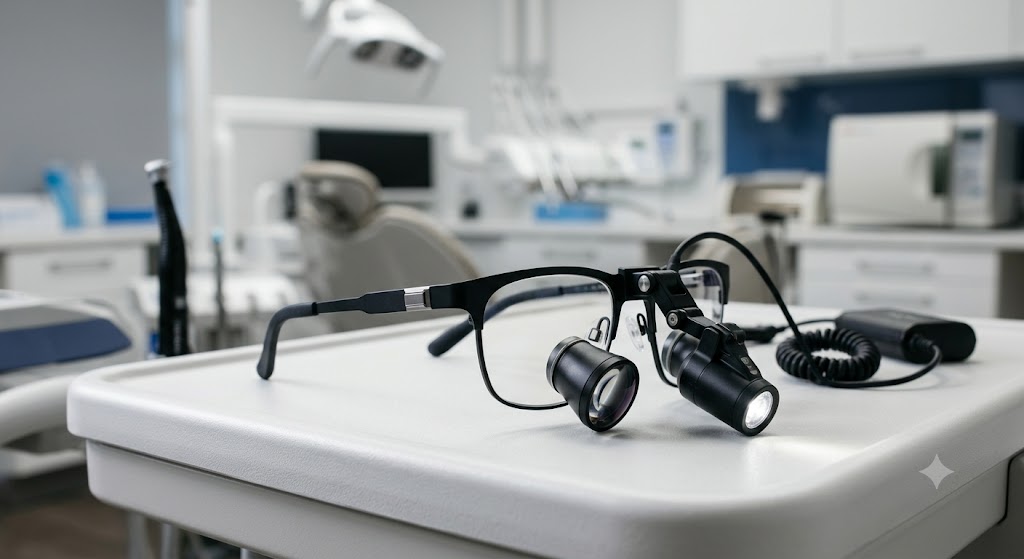
Many students view loupes as an optional luxury or a tool they can put off buying until their upper clinical years. However, data published in prominent journals like the Journal of the American Dental Association (JADA) indicates that musculoskeletal pain often starts during dental school. Establishing correct habits with high-fidelity, distortion-free optical instruments ensures you maintain ideal spinal alignment from day one.
How to Choose the Right Loupe for Dental School: 4 Key Specifications
Evaluating clinical optics requires looking past aesthetic frames. You must assess the underlying physical attributes that match your unique anatomical dimensions.
1. Magnification
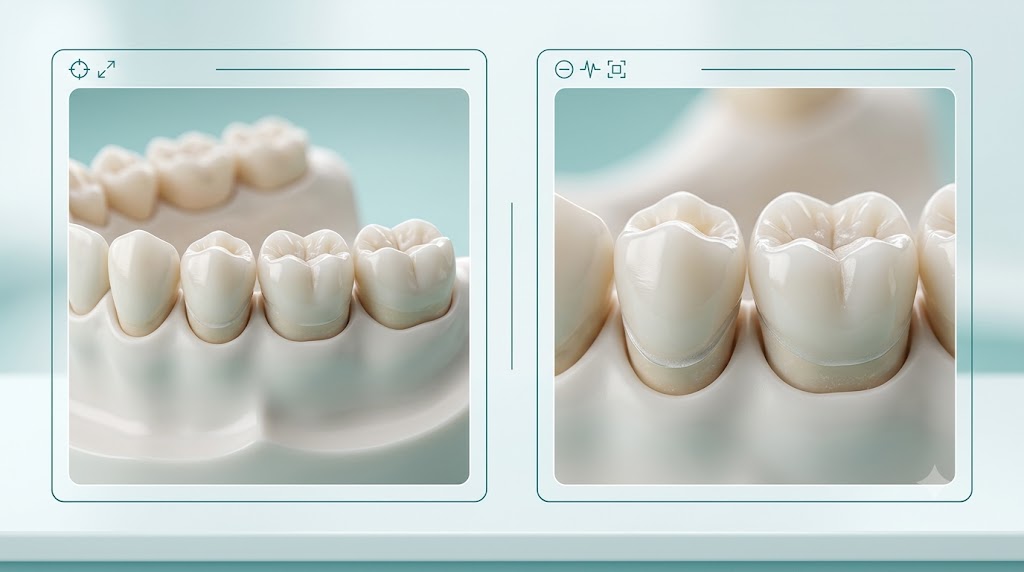
For most dental students, a magnification factor of 2.5x to 3.0x offers the perfect sweet spot. This allows you to view an entire quadrant clearly while getting used to working under magnification. Higher power options (like 3.5x and up) narrow your field of view considerably, which can feel disorienting during your initial clinical experiences.
2. Declination Angle
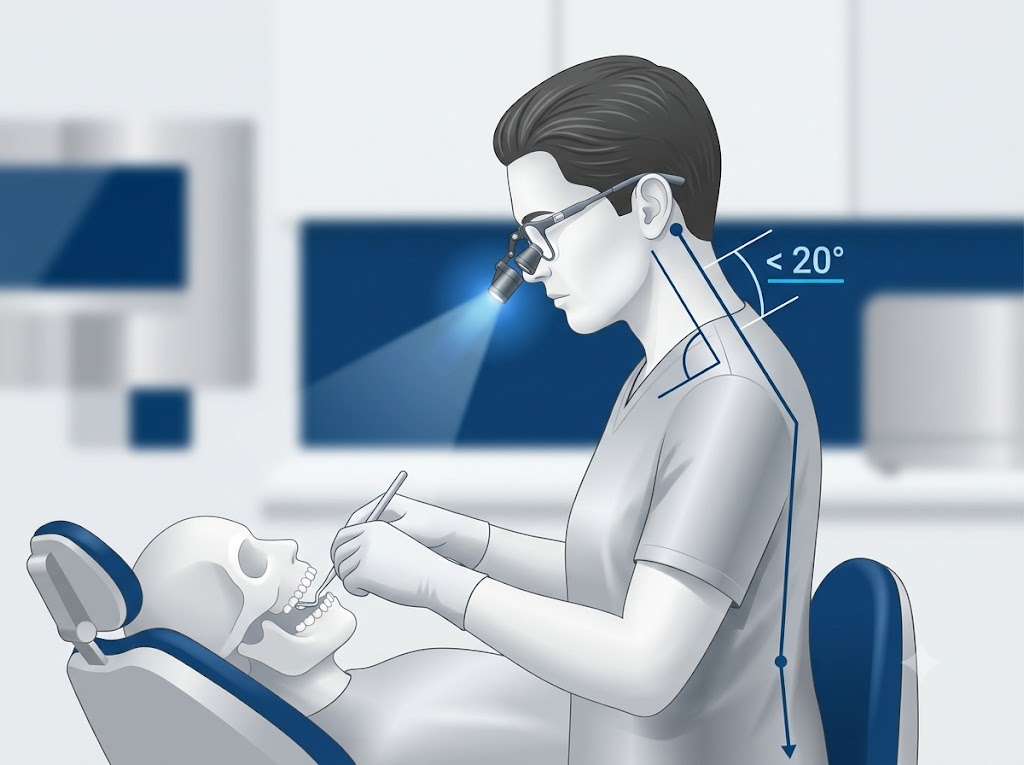
The declination angle measures how downward the lenses slope relative to your eyes. An optimal declination angle allows you to look down into the oral cavity while keeping your neck straight and comfortable. It is essential to ensure this angle matches how to measure your working distance at a standard dental chair to prevent tilting your neck forward past 20 degrees.
3. TTL (Through-the-Lens) vs. Flip-Up
Through-the-Lens (TTL) loupes have the optical barrels drilled directly into the carrier lenses. They are custom-tailored to your interpupillary distance, offering a wider field of view and a lighter build. Flip-Up loupes sit on a hinge configuration on the outside of the frame. While they are slightly heavier, they allow you to flip the barrels out of the way to talk to patients or check charts without removing your glasses.
4. Weight and Durability
Every gram matters when an instrument rests on your nose bridge for six to eight hours a day. Premium options feature medical-grade lightweight titanium or carbon fiber construction. Selecting lightweight options reduces fatigue and helps prevent headaches brought on by constant pressure.
Traditional vs. Ergonomic Deflection Loupes: Which is Best for Students?
Recent innovations in dental ergonomics have introduced deflection (or refractive) optics to the profession. Unlike traditional straight-line barrels that require looking downward, deflection loupes use internal prisms to look straight ahead while projecting the image from the oral cavity directly to your eyes. This design lets you keep your head completely upright, protecting your cervical spine.
While traditional loupes remain popular due to their intuitive learning curve, ergonomic deflection models are quickly becoming a favorite for students who prioritize proactive neck protection. For an in-depth breakdown, read our Best Ergonomic Deflection Loupes of 2026 or our detailed detailed Andau Ergonomic Loupes review.
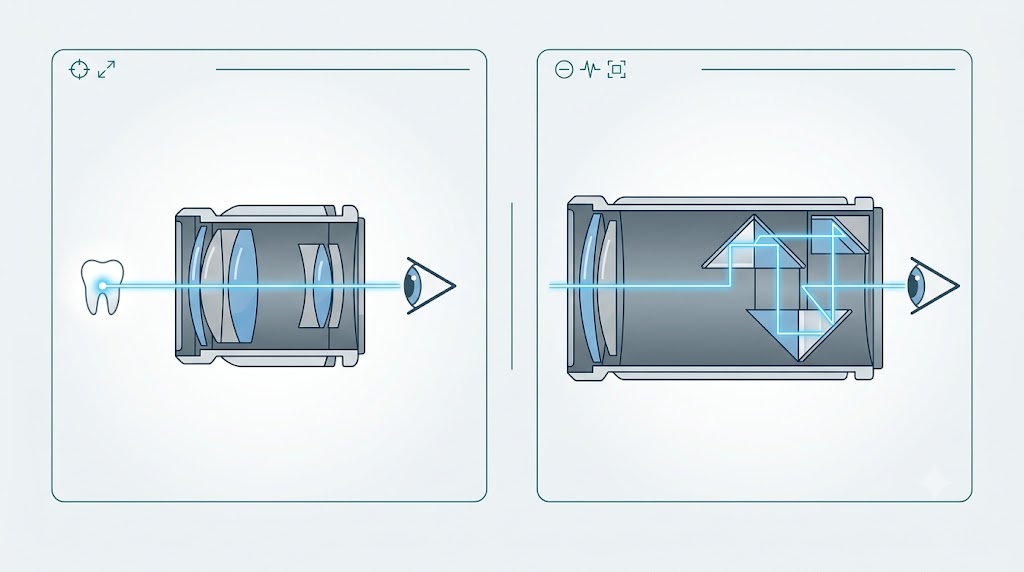
Scientific Validation Note
Data from the International Journal of Dental Hygiene shows that adopting deflection prism optics significantly reduces upper trapezius and cervical muscle activation during long restorative sessions compared to traditional non-prismatic systems.
Don't Forget the Light: The Role of Coaxial Dental Headlights
Even the finest dental loupes can fail to perform optimally if the oral cavity is poorly illuminated. Shadowed fields force your eyes to strain, even at proper magnification levels. A shadowless, co-axial dental headlight mounts directly onto the frame of your loupes, casting intense, uniform light exactly where you look. For full configurations, reference our complete guide to dental headlights.
Top Recommended Dental Loupes for Students (Comparison Table)
The following table summarizes top professional entry configurations that meet institutional requirements for preclinical and clinical execution.
| Product Category | Best For | Key Optical Feature | Action Link |
|---|---|---|---|
| Clinical 2.5x TTL Prism Starter | Pre-clinical Basics & Wide FOV | High-transmittance anti-reflective coating | Check Options |
| Ergonomic Deflection 3.0x | Complete Cervical Spine Relief | 90-degree internal prism shift mechanics | Check Options |
| Ultra-Lightweight 3.0x Flip-Up | Shared Environments & Adjustability | Dual-hinge precision adjustable chassis | Check Options |
Detailed Product Evaluations
Professional Clinical 2.5x TTL Optics
Best For: Dental students entering pre-clinic who require an expansive field-of-view to grasp full-arch relationships easily.
This through-the-lens system balances featherlight framing with highly polished glass optics, allowing a smooth adjustment period for early-career students.
Pros
- Extremely wide depth-of-field
- Minimizes peripheral distortion
- Extremely light structural load
Cons
- Fixed customized alignment prevents adjustments if shared
- Magnification limited for fine endodontic work
Advanced Ergonomic Deflection 3.0x System
Best For: Students experiencing early back or neck pain who want a long-term posture investment.
Using advanced internal micro-prisms, this model bends your line of sight downward so your chin can remain neutral and level.
Pros
- Completely straight neck posture
- Reduces chronic trapezius fatigue
- Bright, high-definition prism clarity
Cons
- Higher baseline price tier
- Takes longer to get used to spatial movements
Ultra-Lightweight 3.0x Flip-Up Clinical Loupes
Best For: Students looking for cost-effective adjustability across changing operatory setups.
Features a multi-jointed manual adjustment system that lets you tweak your settings on the fly without needing factory remeasuring.
Pros
- Highly adjustable declination and pupil distance
- Easy to flip out of view for face-to-face communication
- Cost-effective entry option
Cons
- Slightly heavier front profile due to the hinge
- Frequent adjustments may be needed over time
Dental School Vendor Day: How to Negotiate and What to Ask
Vendor Day can feel a bit overwhelming with so many sales representatives competing for your business. To get the best deal, remember that you hold the leverage as a student entering a decades-long purchasing lifecycle. Always inquire about extended institutional warranties, included protective travel cases, and complimentary prescription lens upgrades.
Download Our Free Vendor Negotiation Template
Get a complete printout checklist of specific questions, warranty templates, and pricing match metrics to print and carry to your school's vendor day.
Frequently Asked Questions About Student Loupes
Can I change my magnification power later if I choose a TTL loupe?
No, because Through-the-Lens (TTL) optics are drilled permanently into the carrier glass. Changing magnification later requires sending them back to the manufacturer to replace the barrels, or investing in a separate pair.
How long does it take to get used to working with dental loupes?
Most dental students experience an adaptation window of two to three weeks. It is best to begin practicing on simple plastic typodont blocks before using them during live patient care.
Should I buy cheap hobby magnifiers online to save money?
No. Non-clinical hobby glasses feature cheap plastic lenses that lack correct alignment and create fish-eye distortion. This can result in severe eye strain, frequent headaches, and poor treatment results. True professional clinical instruments are necessary for proper patient care and vision protection.
Conclusion & Next Steps for Your Dental Career
Choosing your first dental loupes is an investment in your occupational health and clinical precision. By selecting an appropriate magnification, verifying your declination angle, and matching your setup with a high-quality coaxial headlight, you set yourself up for a long, healthy career in dentistry. For a deeper look at comprehensive options, check out our comprehensive modern dental loupes guide.
Ready to Secure Your Clinical Vision?
Explore high-quality, student-vetted medical-grade optical setups to safeguard your posture early in your career.
View Student Dental Loupes on Amazon